Quick answer
What is the fastest way to lower an AI API bill?
Create a cost ledger for one request: input and output tokens, retrieval, tools, retries, fallbacks, and the accepted result. Fix the largest avoidable line first. Repeated context, unbounded output, duplicate requests, premium-model calls, and silent retries often matter more than a small difference between token rates. This guide covers that loop; the AI pricing models guide explains billing categories, while the cheapest LLM API guide covers live low-price candidates.
What AI API cost optimization means
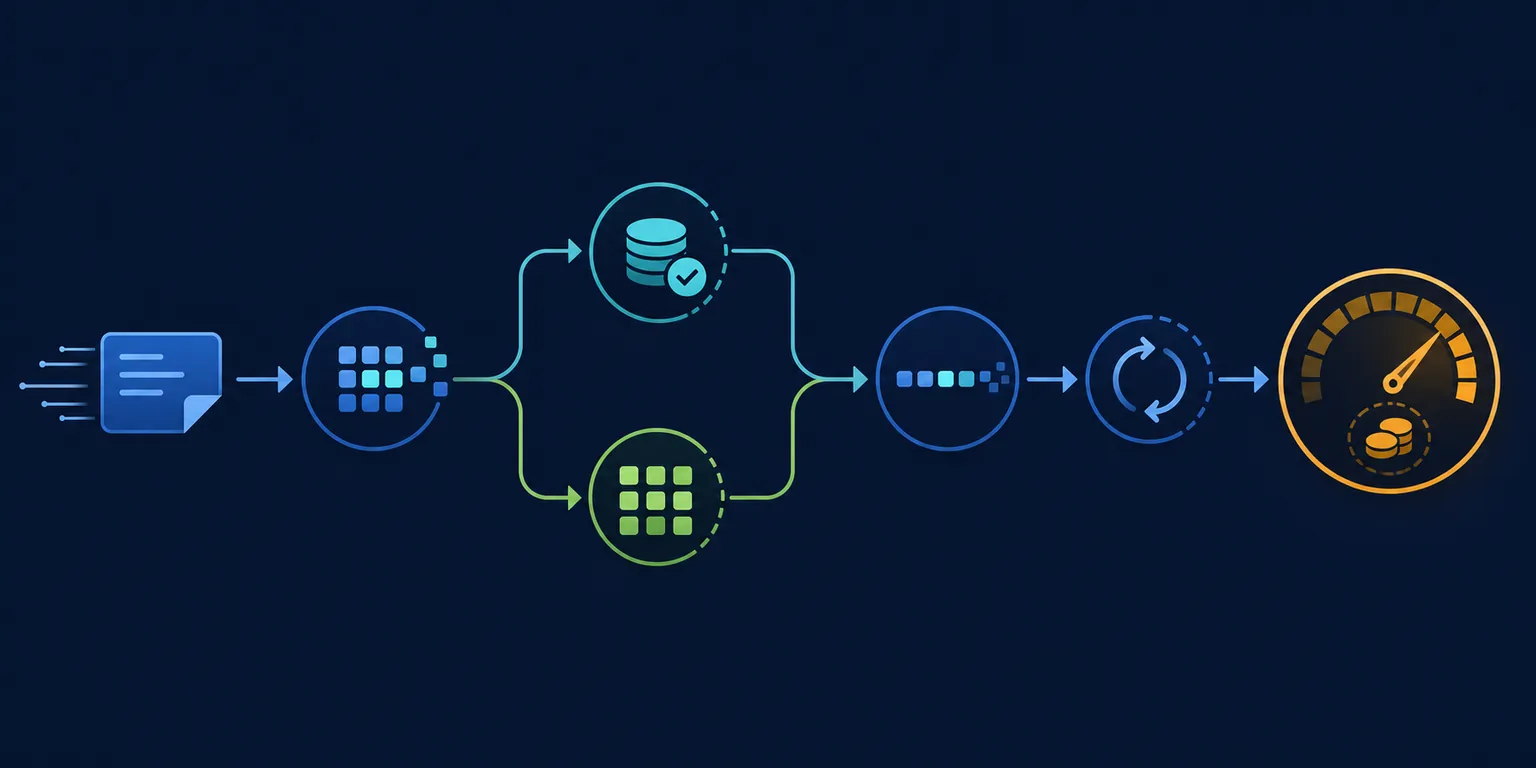
AI API cost optimization is the disciplined reduction of total spend for a useful production outcome. The unit is not always one request. A support answer may need a retrieval call, a policy check, a retry, and a human correction. A coding agent may call several models before it returns an accepted patch. If you compare only the first model call, the estimate hides the work that creates the bill.
Use three boundaries. Usage cost covers input, output, cached, batch, image, audio, search, or tool units. Workflow cost adds retries, fallbacks, retrieval, storage, and orchestration. Outcome cost includes failed tasks, review time, and the quality threshold. Optimizing the wrong boundary can make a dashboard look better while the product costs more to operate.
See it
Attribute tokens and feature calls to a team, feature, route, model, and request ID.
Change it
Test context, cache, batch, routing, and output controls one lever at a time.
Prove it
Compare cost per accepted task with quality, latency, and fallback rate.
Measure the cost of one complete request path
Start with a request ledger before changing prompts or providers. Capture the model, channel, region, input/output tokens, cache reads and writes, batch eligibility, tools, retrieval volume, retries, fallbacks, latency, and acceptance. A request ID that follows the work across services is more useful than a monthly invoice alone.
total task cost = model usage + feature calls + retrieval/storage + retries and fallbacks + platform allocation| Ledger field | Question to answer | Optimization signal |
|---|---|---|
| Input and output tokens | Which side dominates for this route? | Prompt compression, output cap, or a different model tier |
| Context and retrieval | How much repeated or irrelevant text is sent? | Chunking, ranking, summarization, or prefix caching |
| Retries and fallbacks | Which errors cause a second or third call? | Validation, timeout, backoff, and route-specific limits |
| Accepted result | Did the first result actually solve the task? | Quality gate and cost per successful task |
Use the LLM cost calculator to model the token portion after the ledger is clear. Keep optional charges separate instead of hiding them in a blended rate.
Reduce prompt and context waste
Context grows quietly. A long conversation, a repeated system prompt, or an oversized retrieval chunk can make call 100 several times more expensive than call 1. Before switching models, inspect the text that enters the request. Remove duplicated instructions, stale history, unused tool schemas, and documents that do not change the answer.
- Set a context budget. Give each route a target input range and alert when the p95 request exceeds it.
- Summarize history. Keep decisions, constraints, and unresolved questions instead of forwarding every turn.
- Retrieve narrowly. Rank or filter chunks before generation; more context is not automatically more useful context.
- Cap output by task. A short JSON response and a code patch need different limits. Do not pay for unused prose.
Use the AI token calculator to estimate a representative prompt and response, then compare the measured production distribution. Optimization should reduce waste without deleting the context needed for a correct answer.
Use caching and batching deliberately
Caching and batching solve different problems. Provider prompt caching can reduce the price of repeated eligible prefixes, while semantic or response caching can avoid a model call when the same question has an acceptable stored answer. Batch processing trades immediacy for a lower rate on work that can wait. Document which cache is being used, what makes a hit valid, and how stale data is handled.
- Prefix or prompt cache: keep stable instructions and tool definitions in a consistent position, and measure write versus read tokens.
- Response cache: use a safe key, expiry, and an invalidation rule for answers that depend on changing data.
- Batch route: move offline classification, evaluation, enrichment, or backfills into a delayed queue when the product does not need a synchronous response.
- Fallback behavior: define what happens on a miss, stale entry, or partial batch failure so savings do not become hidden duplicate calls.
Compare hit rate, freshness, latency, and accepted-task cost. A cache that rarely hits or creates expensive invalidation bugs is not an optimization simply because its nominal rate is lower.
Route work to the least expensive capable model
Model routing is a quality decision with a cost outcome. Create a small evaluation set that represents easy, normal, and difficult tasks. A fast lower-cost model can handle routine requests; a stronger model can receive ambiguous, long-context, or failed cases. Keep the route deterministic enough to audit and record which branch was selected.
Compare candidates with the same input/output assumptions in the AI model comparison tool. Then add workflow signals that a price table cannot show: retry rate, tool-call count, latency, refusal rate, structured-output validity, and human correction. A routing policy that lowers token price but doubles retries is not a saving.
- Classify the request using cheap, observable signals such as length, task type, or required capability.
- Send routine traffic to the lowest-cost model that passes the evaluation threshold.
- Escalate only when confidence, validation, or task complexity requires it.
- Review route outcomes monthly and remove branches that do not improve accepted-task cost.
Optimize for cost per successful task
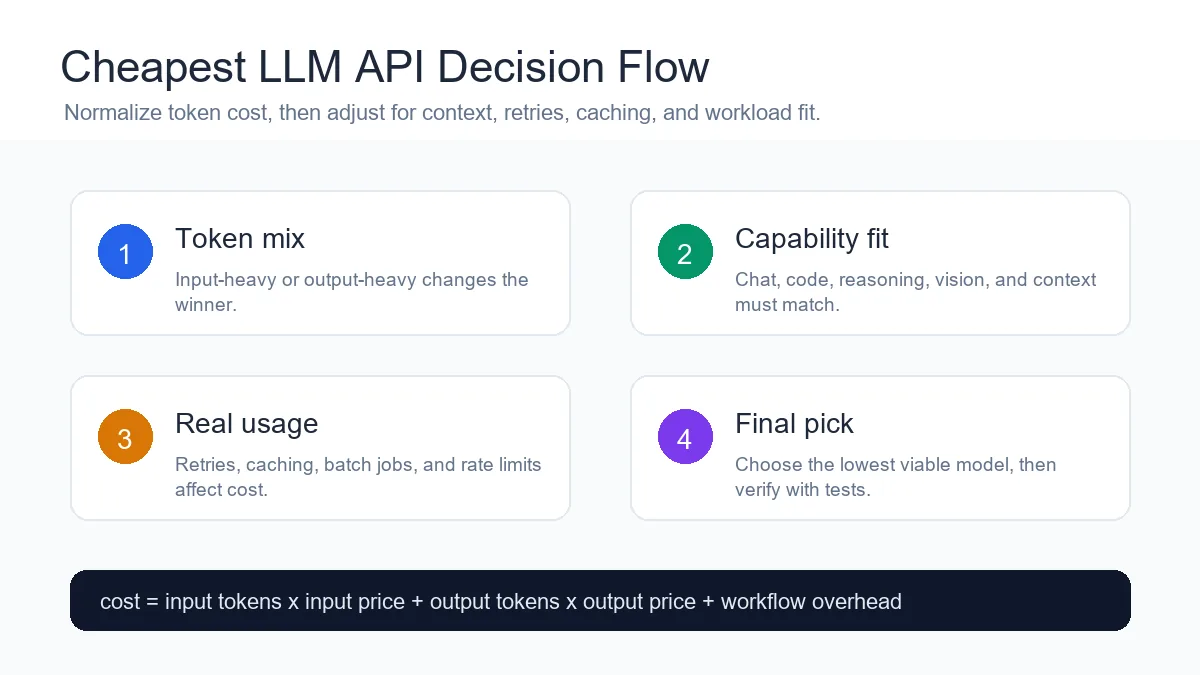
Cost per million tokens is useful for rate-card comparison, but product teams pay for outcomes. Define an accepted result for each route: a valid JSON object, a passing test, a resolved support ticket, or a summary that a reviewer approves. Then calculate the money spent on all attempts divided by accepted results.
cost per accepted task = total workflow spend ÷ accepted resultsTrack the reasons for rejection. If a short output saves tokens but requires manual repair, the real cost may rise. If a stronger model costs more but completes on the first attempt, it can be cheaper at the workflow level. Keep latency and user impact beside the cost number so an optimization does not quietly damage the product.
Build an AI API budget and review loop
Turn the ledger into low, base, and high monthly cases. State requests, input/output mix, cache hit rate, batch share, retry rate, fallback share, and feature charges for each. Assign an owner to assumptions and alert on spend and behavior: p95 context, output length, cache misses, retries, and cost per accepted task.
Review the budget after model releases, prompt changes, traffic spikes, or provider pricing updates. Keep the source URL and check date with the assumption. The latest pricing updates page is a useful change signal, but production decisions should still verify the provider's official terms.
For a concrete workflow, start with a sample prompt in the token calculator, estimate monthly usage in the cost calculator, compare a shortlist, and record the quality threshold that makes the result acceptable. This sequence creates an auditable baseline before any optimization experiment.
AI API cost optimization FAQ
What is AI API cost optimization?
AI API cost optimization is the process of measuring a complete production request, then reducing avoidable tokens, duplicate work, retries, and infrastructure overhead while keeping an acceptable quality and latency level. It is broader than choosing the lowest advertised token rate.
How can I reduce AI API costs without changing models?
Start with visibility, then remove repeated context, cap unnecessary output, cache stable prefixes or repeated answers, batch work that does not need instant responses, and investigate retries. These changes often reduce spend without changing the model contract.
Is model routing always cheaper?
No. Routing can lower the average rate, but a weak route may increase retries, escalations, or human review. Use a representative evaluation set and compare cost per accepted task, not only cost per request.
What should an AI API budget include?
Include input and output tokens, cache writes and reads, batch share, tool or search calls, retries, fallback calls, storage and retrieval, platform fees, and a low, base, and high traffic case. Record the source and date for every price assumption.
How often should I review AI API spend?
Review weekly while a workload is changing and at least monthly after it stabilizes. Recheck after a model release, prompt change, traffic spike, routing change, or provider pricing update.
Official pricing references to verify
Rates, cache terms, and feature meters change. Recheck the official documentation before production procurement:
- OpenAI API pricing for model, cached input, batch, and feature billing.
- Anthropic pricing documentation for Claude model and cache-related terms.
- Google Gemini API pricing for model, cache, batch, and grounding meters.
Reviewed November 16, 2026. AI Pricing Hub provides the comparison and calculator tools linked above; they are planning aids, not provider invoices.